The Complete Guide to Raised Dog Bowls: Benefits, Safety, Choosing the Right Height & More (2026)
If you're considering buying a raised dog bowl, you've probably come across a lot of conflicting advice. Some people say elevated dog bowls improve digestion, others claim they help older dogs with arthritis, while you may also have read warnings about bloat (gastric dilatation-volvulus or GDV). So, who is right?
The answer is that raised dog bowls can be an excellent choice for many dogs, but they aren't automatically the best option for every breed or every situation. The right feeder depends on your dog's size, age, mobility, medical history, and even the shape of their chest.
As a family business that designs and handcrafts premium raised dog feeders in Scotland, we speak to dog owners every day who are trying to decide whether an elevated feeding station is right for their pet. We've heard the same questions hundreds of times:
- Are raised dog bowls better for dogs?
- What height should my dog's bowl be?
- Do vets recommend elevated dog bowls?
- Can raised bowls help older dogs?
- Are they safe for large breeds?
- How do I choose the right size?
This guide brings those answers together in one place. Rather than relying on myths or outdated advice, we'll explain what current veterinary knowledge says, where the evidence is strong, and where decisions should be tailored to your individual dog. Research and veterinary guidance suggest elevated feeding can improve comfort for dogs with certain conditions, such as arthritis, neck problems, or megaesophagus, but it does not universally improve digestion or reduce the risk of bloat. In fact, for some deep-chested breeds at higher risk of GDV, it's sensible to discuss elevated feeding with your veterinarian before making a change.
Whether you share your home with a tiny Chihuahua, an energetic Cockapoo, a loyal Labrador, or a gentle Great Dane, this guide will help you make an informed decision based on your dog's needs—not marketing claims.
What Are Raised Dog Bowls?
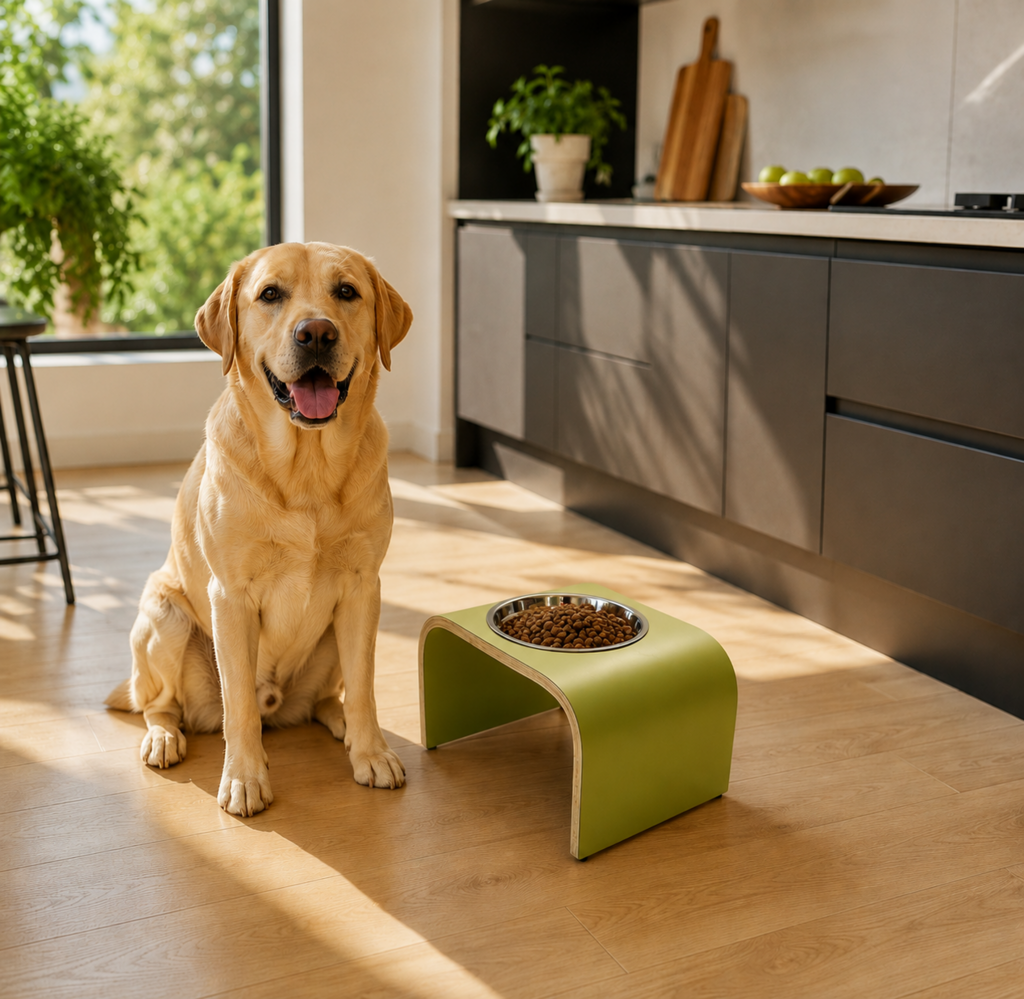
A raised dog bowl, also called an elevated dog bowl, raised dog feeder, or dog bowl stand, is simply a feeding station that lifts your dog's food and water bowls above floor level.
Instead of placing bowls directly on the ground, they're mounted into a sturdy stand designed to bring them closer to your dog's natural eating position.
Raised feeders come in many styles, including:
- Single bowl stands
- Double bowl feeders
- Triple bowl feeding stations
- Adjustable-height feeders
- Wooden handmade feeders
- Metal feeding frames
- Plastic raised bowls
While the principle is the same, the quality varies enormously. A well-designed feeder should do more than raise the bowls—it should be stable, durable, easy to clean, and comfortable for your dog to use every day.
At Lola & Daisy Designer Pets, every feeder is handcrafted in our Scottish workshop using durable, kitchen-grade laminate surfaces with removable stainless steel bowls. We also offer custom height adjustments on many models because no two dogs are exactly alike, and small differences in height can make a meaningful difference to comfort.
Why Have Raised Dog Bowls Become So Popular?
Over the past decade, raised dog bowls have become increasingly common in homes across the UK. Part of that popularity comes from their modern appearance, but many owners also choose them because they believe they may offer practical benefits.
Potential advantages include:
- Reducing the need for some dogs to bend deeply while eating.
- Improving comfort for older dogs with reduced mobility.
- Helping dogs with certain medical conditions feed more comfortably.
- Keeping food and water slightly higher off the floor, which some owners find helps keep feeding areas tidier.
- Integrating more attractively into modern homes than basic bowls placed directly on the floor.
It's important to distinguish between comfort and medical benefit. For some dogs—particularly seniors or those with diagnosed conditions—raising the bowls can make eating easier. For many healthy dogs, however, a raised feeder is primarily a lifestyle and comfort choice rather than a medical necessity.
Did you know?
Lola & Daisy Designer Pets began because we couldn't find a dog feeder that looked beautiful enough to have in our own home. Every design we create today is handcrafted with the same goal—to make your pet's dining area something you'll be proud to display.
The Benefits of Raised Dog Bowls
One of the most common questions dog owners ask is whether raised dog bowls are actually better for their pets. The honest answer is that the benefits depend on the individual dog. While elevated feeding stations aren't essential for every dog, they can provide meaningful advantages for many pets, particularly older dogs, larger breeds and those living with certain medical conditions.
Understanding these potential benefits will help you decide whether a raised dog feeder is the right choice for your companion.
1. Improved Comfort During Mealtimes
Perhaps the most obvious advantage of a raised dog bowl is that it allows many dogs to eat and drink from a more comfortable position.
When food bowls are placed directly on the floor, dogs must lower their heads and necks significantly while eating. For young, healthy dogs this is rarely a problem, but for larger breeds or dogs with reduced mobility, repeatedly bending down several times a day may become uncomfortable.
A correctly sized raised feeder reduces the amount of bending required and can allow some dogs to eat in a more natural posture. Comfort, rather than improved digestion, is one of the main reasons many owners choose elevated feeding stations.
2. Helpful for Older Dogs
As dogs age, they often develop stiffness in their joints and reduced flexibility. Conditions such as osteoarthritis can make everyday movements—including eating and drinking—less comfortable than they once were.
Many owners find that raising food and water bowls makes mealtimes easier for senior dogs by reducing the need to crouch or bend deeply. While a raised feeder won't treat arthritis itself, it may help some older dogs eat more comfortably as part of an overall management plan agreed with their veterinarian.
If your dog has recently been diagnosed with arthritis or another mobility issue, it's always worth asking your vet whether an elevated feeder would be appropriate for their individual needs.
3. Support for Dogs with Certain Medical Conditions
Veterinarians sometimes recommend elevated feeding for dogs with specific health conditions where changing the feeding position may improve comfort or make eating easier.
Examples may include:
- Some dogs with arthritis.
- Certain neck or spinal conditions.
- Some dogs recovering from orthopaedic surgery.
- Dogs diagnosed with megaesophagus, where feeding position forms part of a carefully managed treatment plan.
It's important to remember that elevated feeding is not a substitute for veterinary treatment. If your dog has an underlying medical condition, your veterinarian is always the best person to advise whether a raised feeder is appropriate.
4. A Tidier Feeding Area
Although scientific research has focused mainly on health-related questions, many owners appreciate raised feeders for a much simpler reason—they often help create a cleaner, more organised feeding space.
Food and water remain contained within a dedicated feeding station, making spills easier to manage and helping to define your pet's dining area. This can be particularly useful for enthusiastic eaters or homes with multiple pets.
At Lola & Daisy Designer Pets, we've designed our feeders using durable, kitchen-grade laminate surfaces that are easy to wipe clean after every meal, while removable stainless steel bowls make washing quick and hygienic.
5. Stable Feeding for Enthusiastic Eaters
Lightweight bowls placed directly on hard floors can slide around as dogs eat, especially when larger or more enthusiastic dogs are involved.
A well-built raised feeder provides a stable platform that helps keep bowls securely in place during mealtimes. Stability isn't just convenient for owners—it can also make feeding more comfortable for dogs that dislike chasing their bowls across the kitchen floor.
6. A Beautiful Addition to Your Home
While your dog's comfort should always come first, it's perfectly reasonable to want pet products that complement your home as well.
Many traditional plastic feeding stations are designed with function in mind but do little to enhance modern interiors. Today's handmade raised feeders combine practical design with attractive materials, allowing your dog's dining area to become part of your home's décor rather than something you'd rather hide away.
Because our feeders are handcrafted in a wide range of contemporary finishes—from natural wood effects to modern matt colours—you can choose a design that suits both your pet and your living space.
Are Raised Dog Bowls Better for Every Dog?
Not necessarily.
Healthy young dogs often eat perfectly comfortably from bowls placed on the floor. A raised feeder isn't essential simply because a dog is large or tall.
Instead, elevated feeding should be viewed as one option that may improve comfort, convenience and practicality depending on your dog's individual needs.
The most important considerations are:
- Your dog's age.
- Their mobility.
- Any medical conditions.
- Their size and body shape.
- Advice from your veterinarian where appropriate.
Choosing the correct height is equally important. A feeder that's too high or too low is unlikely to provide the intended benefits, which is why we'll look at measuring your dog correctly later in this guide.
Key Takeaways
- Raised dog bowls can improve comfort for many dogs, particularly seniors and those with reduced mobility.
- Some veterinary conditions may benefit from elevated feeding when recommended by a veterinarian.
- A stable raised feeder can help create a tidier feeding area.
- Elevated bowls aren't automatically better for every dog.
- Choosing the correct height is one of the most important factors when selecting a raised feeder.
Are Raised Dog Bowls Safe? What the Current Evidence Says
One of the biggest questions surrounding raised dog bowls is whether they're safe. If you've spent any time researching elevated feeders online, you've probably found conflicting opinions. Some articles suggest raised bowls are healthier, while others warn they may increase the risk of a serious condition called gastric dilatation-volvulus (GDV), more commonly known as bloat.
The truth is more nuanced than either of these views.
For many dogs, raised feeding stations are perfectly safe and can improve comfort during mealtimes. However, there isn't a single answer that applies to every dog. Factors such as breed, age, medical history and body shape all play a role.
The most important thing is to understand what current veterinary evidence tells us, rather than relying on myths or outdated advice.
What Is Gastric Dilatation-Volvulus (GDV)?
GDV is a serious medical emergency that mainly affects large and giant deep-chested breeds.
The condition begins when the stomach fills with gas and, in some cases, twists on itself. This twist can cut off blood flow to the stomach and other organs, making immediate veterinary treatment essential.
Breeds considered at increased risk include:
- Great Danes
- German Shepherds
- Weimaraners
- Irish Setters
- Standard Poodles
- Dobermans
- Saint Bernards
- Gordon Setters
- Akitas
- Greyhounds
Although GDV can occur in almost any dog, it is far more common in these larger, deep-chested breeds.
Why Are Raised Bowls Linked to GDV?
In the early 2000s, a widely discussed study reported an association between elevated feeding and an increased incidence of GDV in certain large breeds. As a result, many owners were advised to avoid raised bowls altogether.
Since then, veterinary understanding has evolved.
Researchers now recognise that GDV is a complex condition influenced by many different factors, including:
- Breed
- Chest shape
- Age
- Genetics
- Eating speed
- Stress levels
- Meal size
- Exercise around mealtimes
- Previous history of GDV
Because so many factors contribute to the condition, it is difficult to isolate the effect of bowl height alone.
For this reason, current veterinary guidance generally does not recommend that every dog should either use or avoid raised bowls solely because of GDV concerns.
What Do Veterinarians Recommend Today?
Most veterinarians now recommend taking an individual approach.
For example:
- A young, healthy Border Collie may be perfectly comfortable eating from floor-level bowls.
- An elderly Labrador with arthritis may find raised bowls much more comfortable.
- A Great Dane with a family history of GDV may benefit from discussing feeding practices with their veterinarian before changing bowl height.
Rather than asking whether raised bowls are "good" or "bad", it's more helpful to ask:
"Is a raised feeder appropriate for my individual dog?"
That's a question your veterinarian can answer by considering your dog's breed, health, age and lifestyle.
Conditions That May Benefit from Raised Feeding
Although elevated bowls aren't necessary for every dog, they are commonly recommended for certain medical situations.
Examples include:
Arthritis
Older dogs with arthritis often experience stiffness in their neck, shoulders or front legs. Raising the bowls may reduce the amount of bending required during meals, making eating more comfortable.
Neck or Spinal Problems
Dogs with cervical (neck) pain or some spinal conditions may also find a raised feeding position easier.
However, bowl height should be chosen carefully, as every condition is different.
Megaesophagus
Megaesophagus is a condition in which the oesophagus struggles to move food towards the stomach.
For dogs diagnosed with this condition, veterinarians often recommend feeding in a significantly elevated position alongside other management techniques. The exact feeding method depends on the individual dog and should always be guided by a veterinary professional.
Are Raised Dog Bowls Better for Digestion?
This is one of the most common claims you'll find online.
While many owners feel their dogs appear more comfortable eating from raised bowls, there is currently no strong scientific evidence that elevated feeders improve digestion in healthy dogs.
Some dogs naturally prefer eating from a raised position, while others show no noticeable difference at all.
Comfort and convenience remain the strongest reasons for choosing a raised feeder rather than expecting digestive benefits.
Our Advice
If your dog is healthy and comfortable eating from floor-level bowls, there may be no medical reason to change.
If your dog is:
- getting older,
- showing signs of stiffness,
- recovering from surgery,
- living with arthritis,
- or has another condition affecting mobility,
a raised feeder may make mealtimes more comfortable.
If your dog belongs to a breed known to have a higher risk of GDV, or has an existing medical condition, it's always sensible to discuss feeding height with your veterinarian before making any changes.
The goal is not to find a one-size-fits-all answer, but to choose the feeding arrangement that best suits your own dog.
Key Takeaways
✔ Raised dog bowls are safe for many dogs when used appropriately.
✔ GDV is a complex condition influenced by many factors—not simply bowl height.
✔ Deep-chested breeds should have feeding practices discussed with their veterinarian.
✔ Raised feeders may improve comfort for dogs with arthritis, neck pain or some other medical conditions.
✔ Choosing the correct height is often more important than simply raising the bowl.
Which Dogs Benefit Most from Raised Dog Bowls?
Choosing the right feeding setup for your dog isn't just about appearance—it should also reflect your dog's size, age, health and individual needs. While elevated dog bowls aren't essential for every pet, many dogs can benefit from eating from a comfortable height.
Below are some of the situations where raised dog bowls may be particularly helpful.
Large and Giant Breed Dogs
Large breeds naturally have to bend much further to reach food placed on the floor. Over time, repeatedly lowering their head and neck several times each day can become uncomfortable, particularly as they grow older.
Breeds that commonly benefit include:
- Labrador Retriever
- Golden Retriever
- German Shepherd
- Standard Poodle
- Weimaraner
- Dobermann
- Boxer
- Rhodesian Ridgeback
- Rottweiler
- Bernese Mountain Dog
- Great Dane
- Newfoundland
- Irish Wolfhound
- Leonberger
- Saint Bernard
Many owners of these breeds choose raised dog bowls simply because they allow their dog to eat and drink in a more natural standing position.
Senior Dogs
As dogs age, many develop stiffness in their joints, reduced flexibility and slower movement.
Conditions such as:
- Osteoarthritis
- Hip dysplasia
- Elbow dysplasia
- Degenerative joint disease
can make bending down to floor-level bowls uncomfortable.
An elevated feeding station reduces the distance a dog needs to lower its head, making mealtimes less physically demanding. While a raised feeder won't treat arthritis, it can improve comfort as part of an overall management plan recommended by your veterinary surgeon.
Dogs Recovering From Injury or Surgery
Following certain orthopaedic procedures or spinal injuries, vets may recommend reducing unnecessary bending during recovery.
Examples include:
- Cruciate ligament surgery
- Hip surgery
- Spinal procedures
- Neck injuries
- Shoulder injuries
Always follow your veterinary surgeon's specific advice, but in many cases a raised feeder forms part of making everyday activities easier during rehabilitation.
Dogs With Neck or Back Problems
Certain medical conditions make repeated neck flexion uncomfortable.
These include:
- Cervical disc disease
- Spondylosis
- Chronic neck pain
- Some spinal conditions
For these dogs, eating from an elevated bowl may reduce strain during meals.
Dogs With Megaesophagus
One of the clearest medical indications for elevated feeding is megaesophagus.
Megaesophagus prevents food moving normally from the mouth to the stomach because the oesophagus loses its normal muscular function.
Veterinary professionals often recommend feeding these dogs in a much more upright position, sometimes using specially designed feeding chairs such as Bailey Chairs. Standard raised bowls alone are not sufficient for many affected dogs but may form part of a wider feeding strategy under veterinary guidance.
Brachycephalic Breeds
Flat-faced breeds sometimes find eating from very low bowls awkward due to the shape of their skull and shortened airways.
Examples include:
- French Bulldog
- English Bulldog
- Pug
- Boston Terrier
- Boxer
- Shih Tzu
Some owners report that a modestly elevated bowl makes eating more comfortable, although every dog is different.
Puppies
Healthy puppies generally do not require raised bowls.
During growth, it's usually more important to:
- feed an appropriate diet
- use correctly sized bowls
- establish good feeding routines
- allow comfortable posture
If your puppy has an underlying medical condition, your vet may recommend a different feeding arrangement.
Small Breed Dogs
Small breeds can also benefit from elevated feeders, particularly when the height is matched to their size.
Popular breeds include:
- Cavalier King Charles Spaniel
- Cocker Spaniel
- West Highland White Terrier
- Miniature Schnauzer
- Border Terrier
- Jack Russell Terrier
- Miniature Dachshund
- Yorkshire Terrier
- Maltese
- Bichon Frise
- Havanese
A low-profile raised feeder can provide a comfortable feeding height without forcing the dog to stretch upwards.
Every Dog Is Different
The most important point is that there is no single answer that suits every dog.
Factors to consider include:
- breed
- shoulder height
- age
- mobility
- medical history
- eating style
- veterinary advice
Rather than choosing an elevated bowl because it is fashionable, it's better to select one that genuinely suits your dog's individual needs.
At Lola & Daisy Designer Pets, we handcraft raised dog bowls in multiple heights and can even customise the height for many of our feeders. This allows owners to choose a feeding station that not only complements their home but also provides a comfortable feeding position for their dog.
Final Thoughts: Choosing the Right Raised Dog Bowl for Your Best Friend
A raised dog bowl isn't simply a stylish accessory—it's a practical investment in your dog's daily comfort and wellbeing. When chosen correctly, an elevated feeder can make mealtimes more comfortable for senior dogs, large breeds, dogs with arthritis, neck or back problems, and many pets recovering from injury or surgery.
The key is remembering that height matters more than simply buying an elevated bowl. Every dog is different. A Labrador, Dachshund, Border Collie and Great Dane all require different feeding heights, which is why measuring your dog's elbow height is always the best starting point.
Equally important is choosing a feeder that is:
- Stable and difficult to tip over
- Easy to clean and hygienic
- Made from durable, long-lasting materials
- Sized correctly for your dog's food and water requirements
- Designed to complement your home rather than look like an afterthought
At Lola & Daisy Designer Pets, every raised feeder is handmade to order in our Central Scotland workshop using premium materials and durable kitchen-grade laminates designed for everyday family life. Because every dog is different, we can also adjust the feeding height by up to 5 cm higher or lower than our standard sizes, helping you create a feeder that's tailored specifically to your pet.
Whether you're buying your first raised dog bowl or replacing an old feeding station, choosing the correct height, quality construction and durable materials will provide years of comfortable feeding for your companion.
After all, dogs eat every single day. Giving them a comfortable place to enjoy every meal is one of the simplest improvements you can make.
Frequently Asked Questions
Are raised dog bowls recommended by vets?
Many veterinarians recommend elevated feeders for dogs with arthritis, neck pain, spinal problems, laryngeal paralysis or megaesophagus. However, they are not considered necessary for every healthy dog.
How high should a raised dog bowl be?
The top of the bowl should generally sit close to your dog's lower chest, allowing them to eat without bending excessively. Measuring from the floor to the point of the elbow is the most reliable guide.
Are raised dog bowls suitable for puppies?
Most puppies are perfectly happy eating from floor-level bowls while growing. Elevated feeders may become beneficial as larger breeds mature or if recommended by your veterinarian.
Can elevated dog bowls prevent bloat?
Current scientific research has not shown that raised feeders prevent gastric dilatation-volvulus (GDV or bloat). Owners of breeds predisposed to GDV should discuss feeding practices with their veterinarian.
What bowls are best?
High-quality stainless steel or ceramic bowls are generally considered the most hygienic, durable and easiest to clean.
Do raised bowls reduce mess?
Yes. Many owners find that elevated feeding stations help keep food and water contained in one area, reducing spills and making cleaning easier.
Explore Our Handmade Raised Dog Bowls
If you're looking for a raised feeder that's both practical and beautifully designed, explore our collection of handmade raised dog bowls.
Available in multiple sizes, colours and premium finishes, every feeder is individually handcrafted to provide years of comfortable feeding while fitting naturally into modern homes.